NASA LaRC SmartLab
Designing a software suite for materials science research collaboration.
Duration
Jul-Sep, 2021
Role
UX Designer
Involved
#
Research
#
Wireframing
#
Documentation


The Problem
I was presented with a project that was no more than an idea at the time. My primary objective was to come up with a potential UI for what was referred to as the "local client," or, the means by which data was to be collected into the SmartLab server.
However, with little to no context for how SmartLab would fit into the Langley Research Center setting, I first set on researching and framing my problem in order to have a more focused approach to the design.
The need for research and discovery
I needed to answer several questions before I could even begin to define the problem for the local client:
What is the typical materials research process?
How is data collected? What happens in the labs both digitally and physically?
What kinds of artifacts are involved in the process and how are those artifacts used?
What are researchers' tasks? Their priorities?
What are their pain points? In what instances are they having to find workarounds? What are those workarounds?


The Solution
Initial research
With so many questions to answer, I employed nearly every possible method available.
Literature review: I read peer-reviewed studies related to laboratory research practices or processes. This led me to studies on the efficacy of electronic lab notebooks and the use of digital technology in research environments.
Competitive analysis: Though I did not conduct a competitive analysis myself, I included it as a recommended exercise after doing brief survey of the variety of other CMS and ELN platforms currently in the market.
Heuristic review: I conducted a heuristic review of what had been built of the SmartLab system/UI so far to find opportunities for improvement.
User interviews: I had the opportunity to connect with several Langley researchers to ask them directly about their process and workflows. One of the main objectives was to understand the "language" of the lab and how each individual understands certain terminologies. This would help inform labels and messaging in the system.
User archetypes: Based on the interviews, I was able to define three primary user archetypes. These archetypes were used to inform which parts of the system to prioritize.
Visualizing solutions
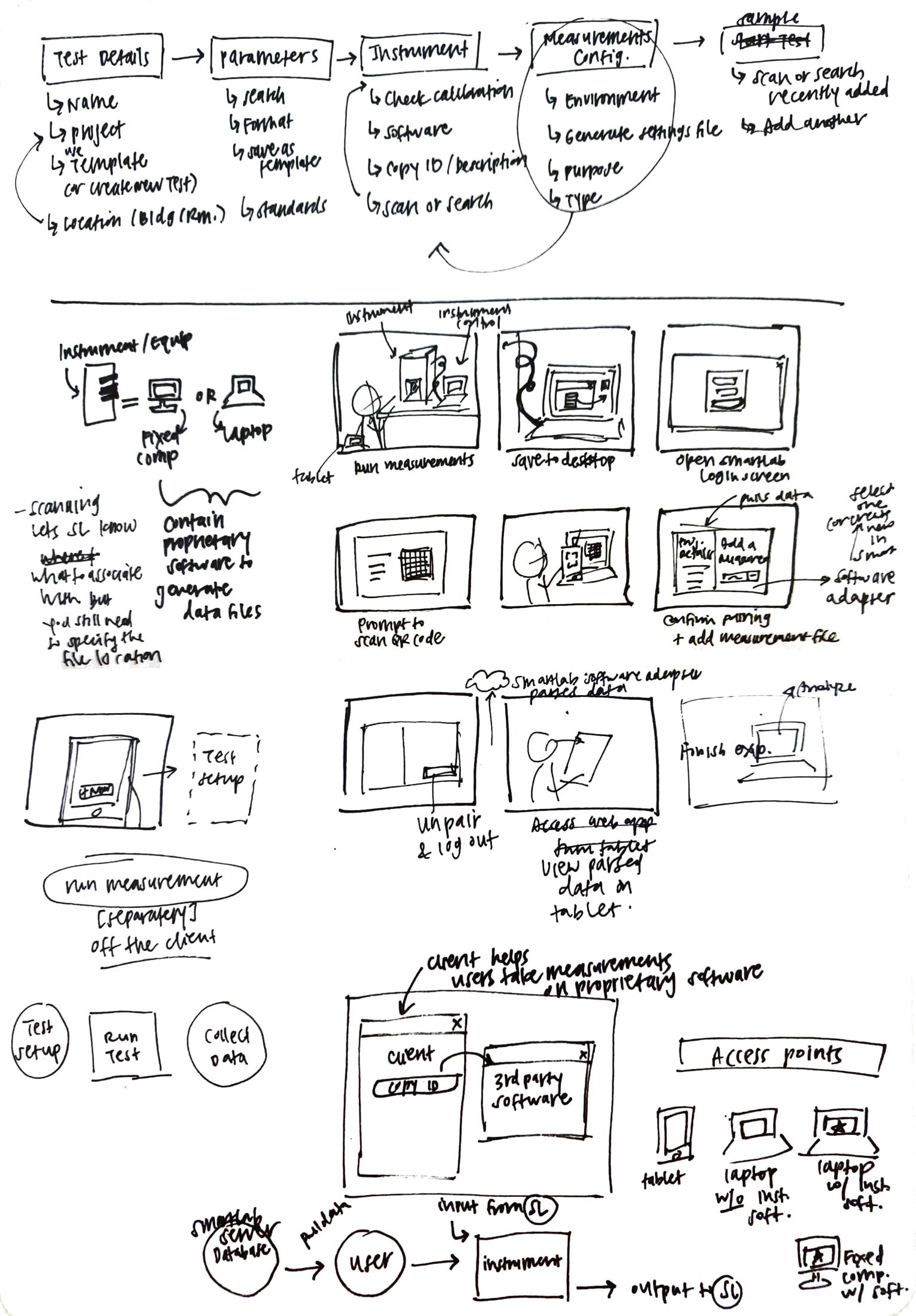
After defining my main problem statement, I went through an iterative process of visualizing solutions using methods like storyboarding, sketching, wireframing, and creating diagrams such as flowcharts. This also allowed for a more collaborative design process where feedback was crucial to each iteration.


The Impact
Beyond an internship
This experience was far beyond an internship as I was not directly working with any another UX professional, but rather worked directly with the engineers on the team to envision the new SmartLab experience. For the team, having me as an intern allowed them to better understand the user perspective when developing the product. Having mockups to visualize possible UI designs as well as flowcharts that proposed interactions between platforms (e.g. transferring data from lab equipment into the SmartLab system) shaped the future of the system as one that could actually fit in their real worlds.
Final deliverables
Though I did not experience an iterative design cycle during this project, I was able to hand off all my research, findings, insights, mockups, and prototypes into a single report to the team.